
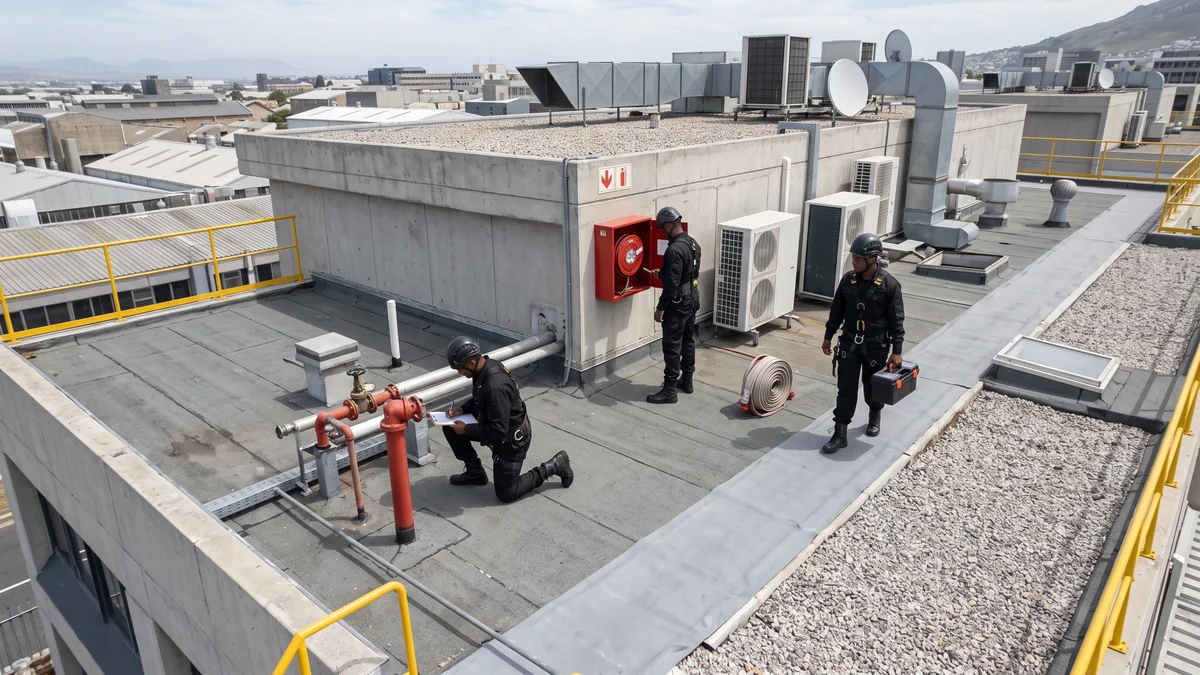
Fire Hydrant Testing South Africa covers the water supply the fire service connects to: hydrants, standpipes and landing valves, tested for flow and pressure and certified annually. Send one request and compare quotes.
Tell us how many hydrants and get quotes.
Get the Best QuoteWhat Testing Involves
- Flow test. Measured discharge rate, in litres per second.
- Pressure test. Static and running pressure at the outlet.
- Valve operation. Each valve opened, closed and checked for passing.
- Physical condition. Couplings, caps, chains, thread condition and paint.
- Certificate. Results recorded and certified, with the test date.
Installation Work
- Hydrant points. Positioned by coverage distance across the site.
- Standpipes. Riser and landing valves inside multi-storey buildings.
- Underground mains. Excavation, pipe, thrust blocks and reinstatement.
- Pump sets. Where town pressure alone cannot meet the duty.
- Tanks. Stored water where supply is unreliable or insufficient.
Common Findings
- Painted-shut valves. The most frequent fault, and a quick fix.
- Missing couplings. Caps and chains go missing and are rarely noticed.
- Inadequate pressure. Often a municipal supply issue rather than a site one.
- Blocked access. Parking, landscaping and stock stored over hydrant points.
Fire Hydrant Testing Prices
Ballpark prices so you can check a quotation.
| Item | Ballpark price |
|---|---|
| Flow and pressure test, per hydrant | R850 - R2,800 |
| Annual service, per hydrant | R650 - R1,900 |
| Standpipe and landing valve service, per floor | R450 - R1,500 |
| New hydrant installed, above ground | R12,000 - R38,000 |
| Underground main, supplied and laid, per metre | R900 - R2,800 |
| Fire pump set, supplied and installed | R85,000 - R450,000 |
| Test certificate, per site | Usually included |
Prices JUST UPDATED. Ballpark figures, rounded, excluding VAT. They reflect typical South African supplier and contractor rates for fire protection work. They are not our prices or quotations, and no provider is bound by them. Confirm what each quotation includes, such as travel, certificates, consumables, after-hours work and minimum callout fees.
Get a price for testing your site.
Get the Best QuoteWhat Affects the Price
- Number of points. Per-hydrant rates drop with volume on one site.
- Access. Hydrants behind parking or landscaping take longer to reach and test.
- Water disposal. Flow testing discharges a lot of water that has to go somewhere.
- Excavation. On installations, ground conditions and reinstatement dominate the cost.
- Pump requirement. Whether town pressure meets the duty or a pump set is needed.
- Certification scope. Full hydraulic certification costs above a routine service.
What to Include in Your Request
- How many hydrants. And whether any are underground or in pits.
- Standpipes. Number of floors and landing valves, if a multi-storey building.
- Site plan. Even a rough sketch of where the points are helps.
- Last test date. On the existing certificate, if you have one.
- Known problems. Valves that will not turn, missing caps, low pressure.
Before Testing Day
- Clear access. Move vehicles and stock away from every point beforehand.
- Plan the water. Flow tests discharge a lot of water, and it must drain safely.
- Tell the neighbours. Testing can drop pressure on a shared supply temporarily.
- Keep the certificate. Insurers and councils ask for the most recent one.
Fire Hydrant Testing FAQs
How often should hydrants be tested?
Annually is the standard expectation, with a visual check more frequently. Insurers and local by-laws are what usually set the interval for a given site.
What if the pressure is too low?
First establish whether it is the municipal supply or the site's own pipework. The remedies are very different: one is a pump set and tank, the other is a conversation with the municipality.
Can hydrant testing be done during business hours?
Usually, though it discharges a lot of water and briefly drops pressure. Sites with sensitive processes often prefer early morning.
Who may certify a hydrant?
A registered person for the scope. Ask for the registration number and check the certificate names the test results, not only a pass.
Hydrant work is one of the services quoted through Fire Safety Inspections South Africa alongside hose reels, sprinklers and detection.
Related Services
Get the Best Quote, Fast
Client Reviews
Powered by leaderr